By Wayne van der Westhuizen, Pr Tech Eng, MEng | Medicrete
Cracking, rust staining and loose concrete can be the first indications that a building needs attention. For property owners and facilities managers, the challenge is deciding which defects need monitoring, which require investigation and which call for urgent action.
This guide explains the warning signs in commercial concrete structures, the limits of visual inspection and how a condition assessment supports a repair decision. A photograph or a crack measurement cannot, on its own, establish whether a structure is safe.
Key takeaways
- Look for cracking, rust staining, leaks, white deposits, delamination and spalling, particularly around joints, exposed edges and persistently wet areas.
- Reinforcement corrosion is an important cause of deterioration. Carbonation and chloride contamination can contribute, but neither should be diagnosed from location or appearance alone.
- Falling concrete, new or increasing deformation and cracking associated with possible structural distress require urgent professional attention.
- A useful investigation combines the building history, inspection, targeted tests and engineering interpretation. Repair selection follows the diagnosis.
What are the most common visible signs of concrete deterioration?
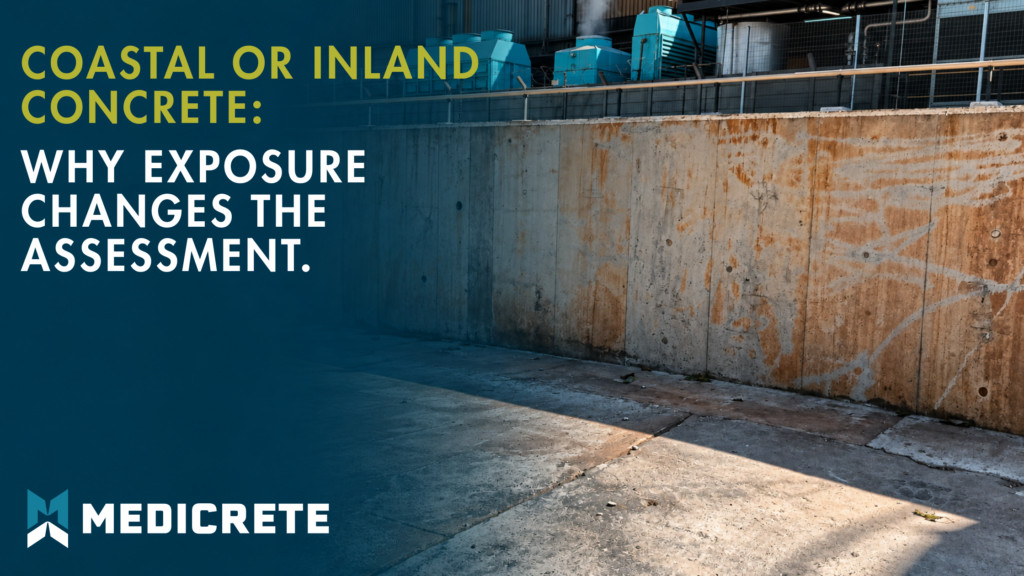
Common visible signs include cracks, rust stains, spalling, exposed reinforcement, damp patches, leakage, white deposits and surface breakdown. Look at parking decks, balconies, slab soffits, beams, columns, façades and basement walls. Delamination may remain concealed and require a controlled survey to identify it.
The same symptom can have several causes. The observations below help identify what needs investigation; they are not a substitute for diagnosis.
| Observation | Possible explanation | Where to inspect |
|---|---|---|
| Cracks along bar lines | Expansion associated with reinforcement corrosion; other causes must be considered. | Soffits, beam edges and column corners |
| Rust staining | Corrosion of reinforcement, embedded metal or an external source. | Edges, joints and areas below metal fixtures |
| Spalling or exposed steel | Loss of cover associated with corrosion, impact, fire or other deterioration. | Balconies, beams, columns and exposed edges |
| Dampness or white deposits | Moisture transport, leakage and deposition of dissolved material. | Basements, joints, cracks and slab soffits |
| Map cracking or surface breakdown | Possible shrinkage, material reactions, weathering, abrasion or chemical exposure. | Floors, walls and exposed surfaces |
| New or increasing sagging | Possible structural distress requiring assessment. | Slabs, beams and cantilevers |
Why concrete deteriorates in South African buildings
Exposure, construction quality, detailing, drainage, use and maintenance all influence deterioration. Coastal salt exposure is relevant, but inland buildings can also experience aggressive conditions, persistent leakage and contamination from industrial processes.
Carbonation and reinforcement corrosion
Carbon dioxide reacts with cement hydration products and reduces concrete alkalinity. If carbonation reaches the reinforcement, the conditions that protect the steel can be lost. Whether significant corrosion develops also depends on factors such as moisture and oxygen availability. Cover depth, permeability and cracks influence the assessment.
Chloride exposure
Chlorides can disrupt the protection of reinforcing steel even where the concrete remains alkaline. Marine exposure is an important source, but contaminated materials and some industrial environments can also contribute. Carbonation and chloride contamination may coexist. Testing is needed to establish their significance at a particular structure.
Other causes of damage
Cracks and spalls can also result from movement, loading, impact, fire, chemical attack or reactions within the concrete. A leaking joint may be a waterproofing defect, a contributor to reinforcement corrosion, or both. An investigation should consider plausible alternatives before a repair system is chosen. [1]
Which signs require an urgent structural assessment?
Seek urgent professional assessment when concrete is falling, a slab or beam develops new or increasing sagging, significant cracks appear suddenly, or damage suggests possible instability. Cracking near supports or slab–column connections, visibly damaged reinforcement and distress after fire or impact also require prompt attention.
Restrict access to the affected area, including areas below loose overhead concrete. Contact building management and a suitably qualified engineering professional.
Do not enter a potentially unstable area to move vehicles, remove loads, knock off concrete or install temporary supports. These actions require a safe, professionally directed plan.
Do not wait for a monitoring period if cracking is developing rapidly or is accompanied by deformation or falling material. Contact emergency services if there is an immediate threat to life.
EN 1504-9 addresses assessment of safety risks before protection and repair. Where a structure is considered unsafe, appropriate measures must be specified before further repair work proceeds. Temporary supports or removal work can introduce additional risks and should not be improvised. [1]
Is there a crack width that means a building is unsafe?
There is no single crack width that establishes the safety of every concrete structure. Location, orientation, depth, movement, loading and associated defects all matter. A narrow crack in a critical location may warrant more concern than a wider crack in a nonstructural finish.
Fine shrinkage cracks can occur without indicating a loss of load capacity, but they may still affect water tightness or durability. Cracks following reinforcement, changing over time or occurring with rust stains, spalling or distortion need investigation. Monitoring may form part of an engineer’s assessment; it should not delay urgent action.
What causes concrete spalling and how can it be identified early?
Spalling is the loss of pieces of concrete from the surface. One mechanism is reinforcement corrosion: expanding corrosion products can crack and separate the cover before it falls away. However, spalling can also result from other damage mechanisms, so exposed steel does not prove that corrosion caused the original defect.
Possible early indicators include rust staining, cracks along reinforcement and local separation of the cover. Corrosion-related damage does not always follow a visible sequence, and apparently sound areas can contain concealed deterioration.
A competent inspection team may use hammer sounding to locate delamination, supported by suitable access and controls for falling material. Owners should not tap or strike suspect overhead concrete themselves. Cover surveys, corrosion-related testing and targeted sampling can then help establish the extent and likely cause.
How a concrete condition assessment works
The investigation should be designed around the decision the owner needs to make: prioritising maintenance, defining repairs, assessing continued use or investigating a change in loading. Not every assessment needs every available test.
| Stage | Purpose |
|---|---|
| Review the available information | Consider drawings, age, exposure, maintenance records, previous repairs and changes in use. |
| Inspect and map defects | Record accessible cracking, spalling, staining, leakage and deformation, with photographs and locations. |
| Select targeted tests | Investigate relevant questions about cover, reinforcement location, corrosion conditions and concrete quality. |
| Interpret the evidence | Assess likely causes, extent, limitations and whether structural analysis or further investigation is needed. |
| Define the next steps | Provide recommendations appropriate to the agreed scope, including priorities, repair options or further assessment. |
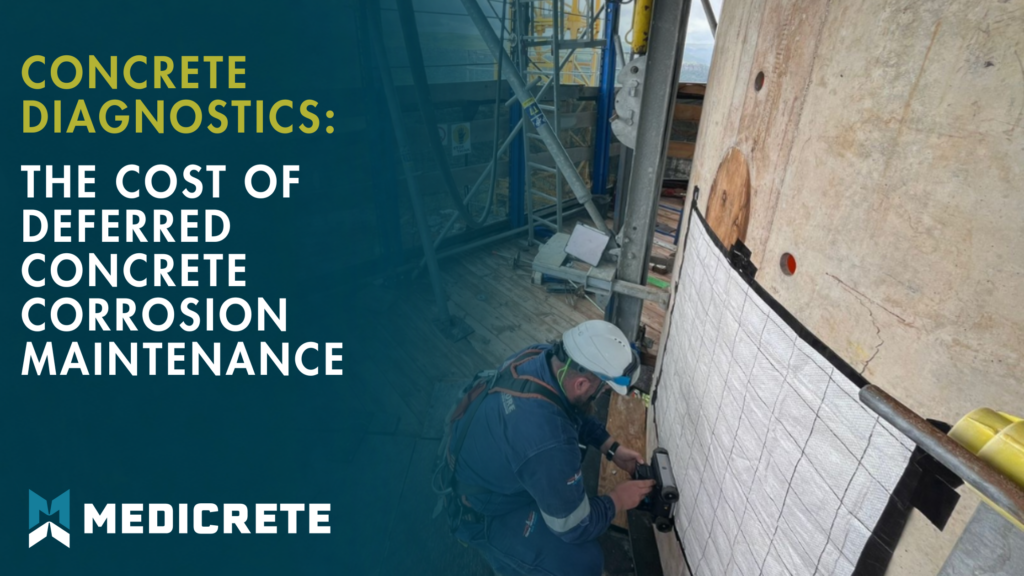
Cover meters and ground-penetrating radar can assist with locating reinforcement and planning intrusive work. They do not independently establish structural capacity. Carbonation-depth tests and chloride profiles help investigate corrosion mechanisms; their results need to be interpreted alongside cover and exposure conditions.
Half-cell potential measurements help assess the likelihood of corrosion activity under the test conditions. They do not directly measure corrosion rate or remaining steel section. Resistivity, targeted exposure of reinforcement and other investigations may provide complementary evidence.
Cores may support strength testing, petrography or chemical investigation. A core result relates to the sampled material and must be interpreted within a suitable sampling and assessment strategy. A single result does not establish the safety of an entire structure.
Medicrete provides concrete diagnostics, condition assessments and repair consulting. The investigation scope and deliverables are agreed for the asset concerned. Detailed structural verification or remaining-service-life modelling may require additional information, analysis and a separately defined scope.
Why patching the visible damage may not solve the problem
A patch can restore missing concrete while leaving the underlying cause unresolved. Persistent water ingress, chloride contamination, vulnerable adjacent reinforcement or continuing movement may cause further damage within or around the repaired area.
A repair strategy should consider the affected structure beyond the visible spall, along with substrate preparation, material compatibility, reinforcement treatment, curing and quality control. EN 1504-9 provides a framework for assessing defects and their causes before selecting protection and repair principles. It is a European standard, not a blanket statement of South African legal compliance. [1]
Early investigation can help owners plan access, manage risk and choose a proportionate intervention. It does not guarantee a minor repair: small visible defects can sometimes indicate a wider concealed problem.
How often should a commercial parking structure be inspected?
A parking structure needs an inspection programme appropriate to its age, condition, exposure, use and applicable legal requirements. Routine observations by facilities staff help identify changes, but do not replace competent-person inspections or a diagnostic assessment when defects are found.
Regulation 11(2) of South Africa’s Construction Regulations, 2014 sets out owner duties for structural inspections by competent persons at least every six months during the first two years and annually thereafter. It also addresses maintenance for safe continued use and keeping inspection and maintenance records. [2]
These inspections should not be confused with a full diagnostic testing programme at every visit. The scope depends on the structure and findings. Defects, aggressive exposure or a damaging event may justify earlier or more detailed assessment. Owners should obtain advice on the current legal requirements applicable to their premises; a scheduled inspection date is never a reason to defer action on a new hazard.
Frequently asked questions
Is rust staining on concrete dangerous?
Rust staining warrants investigation, but it does not by itself establish the source or severity of damage. It may come from reinforcement, other embedded metal or an external source. Staining accompanied by cracks, loose concrete or deformation needs prompt professional attention.
What does concrete cancer mean?
Concrete cancer is an informal term often used for reinforcement corrosion and associated cracking or spalling. It is also sometimes used for other deterioration mechanisms. A useful diagnosis identifies the actual cause rather than relying on the label.
What do white deposits on concrete mean?
White deposits may form when moisture carries dissolved material to a surface and evaporates. Appearance alone cannot establish the source, composition or seriousness. Persistent deposits and leakage should prompt investigation of the moisture path and any associated deterioration.
Can I patch spalled concrete myself?
Structural or overhead spalling should be assessed before repair. Removing concrete can expose additional damage or affect stability, and patching alone may leave the cause unresolved. Repair preparation and application should follow an appropriate specification and safe work method.
Are fine cracks in a new slab always harmless?
No. Fine cracks may be associated with shrinkage, but significance depends on their location, pattern, movement and the slab’s function. Cracks that admit water, develop over time or occur with other distress deserve assessment.
What information helps Medicrete plan an assessment?
Provide the asset location, available drawings, photographs taken from a safe position, repair history, access constraints and the decision you need to make. State whether there is falling material, recent movement or another urgent concern.
Request a condition assessment
If your commercial building shows cracking, spalling, rust staining or persistent leakage, Medicrete can help investigate the cause and define the next steps. Contact us to discuss a condition assessment suited to the structure, its exposure and the decision you need to make.
Request a Medicrete condition assessment
This article provides general information. It cannot establish the safety of a particular structure or replace a site-specific professional assessment.